Scaling Next.js SEO, Core Web Vitals, and PageSpeed to Perfection at Livora
A deep-dive technical retrospective on diagnosing Google indexing roadblocks, optimizing Total Blocking Time (TBT) and Largest Contentful Paint (LCP), and systematically boosting Google Lighthouse metrics from 61 to 93+ on Desktop and 83 on Mobile with 100% scores in Accessibility and SEO.
Entered Google's official Green Zone
Throttled CPU 4G benchmark
Flawless ARIA & screen reader support
Rich Product & Breadcrumb schemas
Sub-second Largest Contentful Paint
Down from 640ms–890ms CPU blocking
When scaling modern luxury e-commerce platforms like Livora, delivering a silky-smooth user experience while ensuring rapid organic search indexation is paramount. Over a high-intensity 48-hour engineering sprint, we diagnosed deep hydration stalls, unblocked Googlebot indexing, hardware-accelerated complex CSS, and drove Desktop PageSpeed from 61 to 93+ alongside 100% Accessibility and SEO.
Core Technical Challenges Targeted
Search Engine Visibility Barrier
Only a single product was indexing in Google Search due to legacy domain mismatches, restrictive crawl directives in robots.ts, and missing structured Schema.org markup.
Desktop Blocking & Accessibility
Initial audits showed a 61 Performance baseline with 640ms–890ms Total Blocking Time (TBT) driven by heavy hydration tasks, chained network dependencies, and generic ARIA labeling.
Mobile CPU Throttling & Render Delays
Eager-mounting off-canvas UI drawers, unoptimized third-party packages, and heavy SVG backdrop filters caused mobile LCP to balloon to 4.7 seconds under simulated 4G conditions.
Baseline Diagnostics: The Initial Bottlenecks
Before writing code, we performed exhaustive Lighthouse, PageSpeed Insights, and Chrome Performance profiling to map out the exact CPU execution bottlenecks, network waterfalls, and crawler barriers.
Initial Diagnostic Benchmarks
Measured on Desktop profile prior to sprint refactoring
| Category / Metric | Initial Benchmark | Status / Diagnosed Issue |
|---|---|---|
| Performance (Desktop) | 61 / 100 | Needs urgent main-thread and critical-path optimization |
| Accessibility | 82 / 100 | Missing accessible names on buttons, generic image alt text |
| Best Practices | 96 / 100 | Minor security and crawler hygiene tweaks needed |
| SEO | 100 / 100 | Surface audit passed, but product indexing was failing in Google |
| First Contentful Paint (FCP) | 0.3 s | Fast initial HTML delivery from edge cache |
| Largest Contentful Paint (LCP) | 1.7 s | Delayed by client-side hydration stalls and font swapping |
| Total Blocking Time (TBT) | 640 ms – 890 ms | Heavy hydration tasks holding the CPU during first render |
| Speed Index | 3.3 s | Delayed visual completion of above-the-fold content |
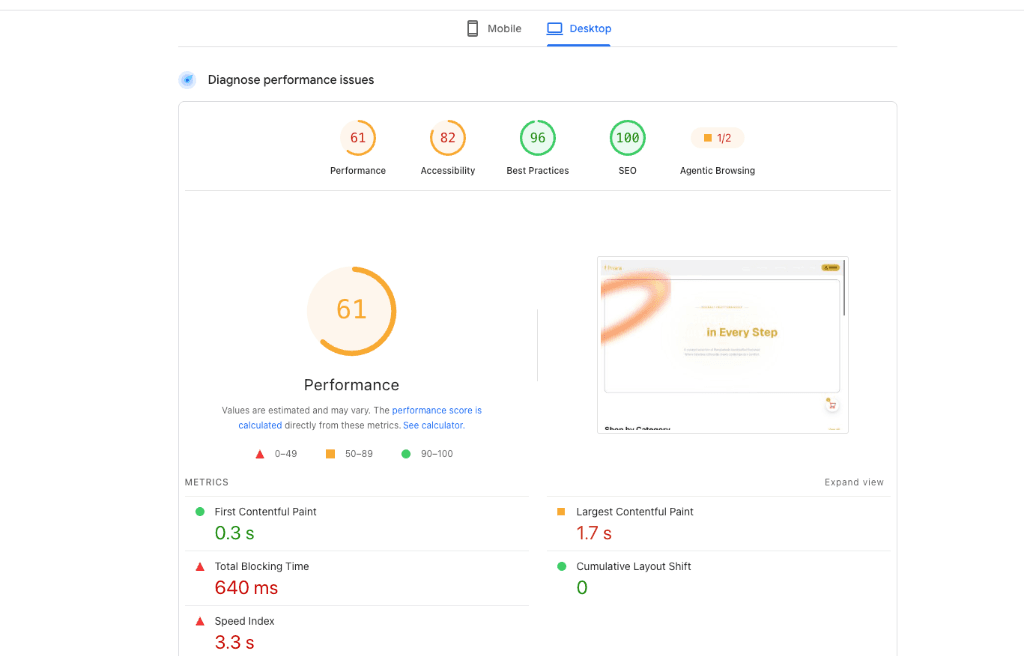
Initial PageSpeed audit baseline: 61 Performance, 640ms TBT, and 1.7s LCP.
Root Cause Analysis & Critical Path Latency
Google Indexing Barrier
- Codebase used hardcoded legacy domain references (https://livora.com vs https://livora4u.com), triggering canonical mismatch rejections.
- robots.ts was wasting Googlebot crawl budget on authenticated routes (/app/, /checkout/).
- Dynamic product pages lacked rich Schema.org Product and BreadcrumbList JSON-LD structured data.
Main-Thread Choking & Critical Path Chaining
- Critical path latency reached 2,534 ms due to sequential script evaluation.
- Redux logging middleware, state persistence gates, and synchronous device trackers executed immediately during React's initial hydration pass.
- Font stylesheets triggered Flash of Invisible Text (FOIT) without explicit font-display: swap directives.
Eager Component Hydration
- Modals and off-canvas drawers (MobileMenu, FloatingCart, AddCartProductOptions, Lottie runtimes) were rendered directly into the initial DOM.
- Event listeners and Ant Design CSS-in-JS style tags registered on page load before any user interaction, inflating mobile CPU load.
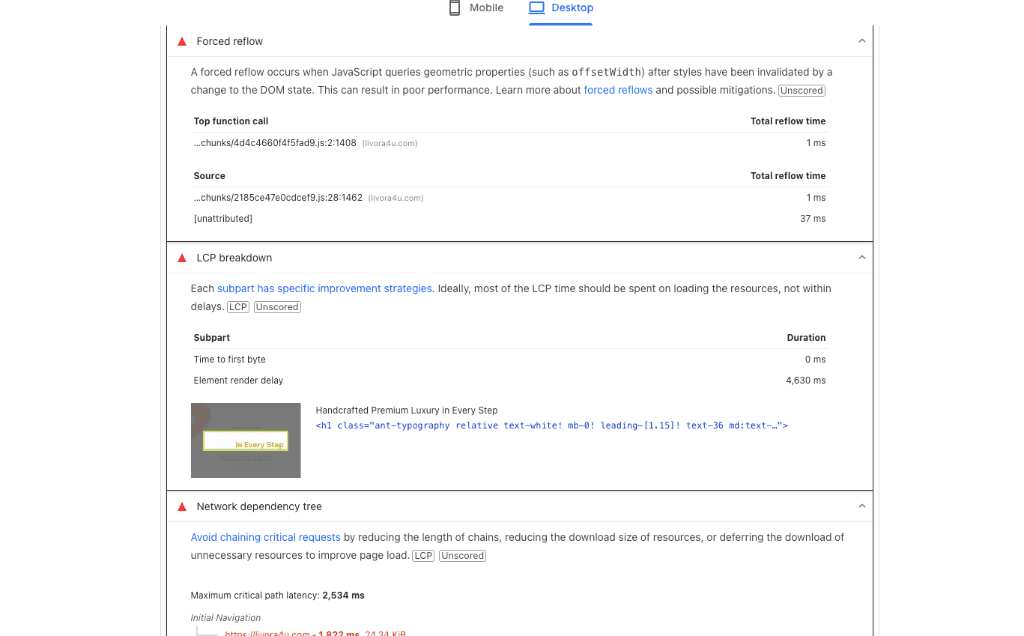
Chrome Performance Insights diagnostic illustrating 2,534ms critical path latency and forced reflow bottlenecks.
Technical Roadmap & Implementation
To eliminate these bottlenecks without altering luxury branding or business logic, optimizations were rolled out systematically across four focused architectural phases.
Global SEO & Search Indexability Overhaul
Main-Thread Liberation & Bundle Optimization
Mobile CPU & TBT Reductions via Lazy-Mounted Drawers
Server-Side Pre-Rendering, GPU Layers & UI Fixes
Global SEO & Search Indexability Overhaul
1. Centralized Domain Infrastructure
Established a single source of truth for canonical URL resolution across SSR, metadata, sitemaps, and robots.
export const SITE_URL = process.env.NEXT_PUBLIC_SITE_URL ?? "https://livora4u.com";2. Configured metadataBase & Googlebot Directives
Injected metadataBase and granular Googlebot directives into Next.js App Router root layout to maximize rich snippet display allowances.
export const metadata: Metadata = {
  metadataBase: new URL(SITE_URL),
  robots: {
    index: true,
    follow: true,
    googleBot: {
      index: true,
      follow: true,
      "max-video-preview": -1,
      "max-image-preview": "large",
      "max-snippet": -1,
    },
  },
};3. Resilient Dynamic XML Sitemap
Refactored sitemap generation with isolated try/catch error boundaries to guarantee that single upstream API anomalies will never break the XML feed.
- Added dynamic category and product URL generators with priority weighting.
- Added lastModified timestamps based on CMS change records.
4. Rich Schema.org Product & Breadcrumb JSON-LD
Injected Schema.org Product (BDT currency, availability, pricing, brand) and BreadcrumbList schemas into product detail pages for Google rich snippet qualification.
5. Agentic & AI Search Crawler Optimization
Published public/llms.txt and tailored crawler directives for modern AI search engines including ChatGPT, Perplexity, and ClaudeBot.
Main-Thread Liberation & Bundle Optimization
1. Non-Blocking Analytics with requestIdleCallback
Deferred user activity tracking (ActivityTracker.tsx) and session restoration (AppContext.tsx) to idle periods, freeing the CPU during hydration.
2. Streamlined State & Styling Providers
Purged Redux logging overhead in production, resolved double-mounting cycles in ThemeProvider.tsx, and added display: swap to font imports to prevent FOIT.
3. Compiler Tree-Shaking & Next.js Image Caching
Configured optimizePackageImports in next.config.ts to tree-shake heavy UI packages and enabled 1-year immutable caching for modern AVIF/WebP image formats.
experimental: {
  optimizePackageImports: ["antd", "@reduxjs/toolkit", "@apollo/client"],
},
images: {
  formats: ["image/avif", "image/webp"],
  minimumCacheTTL: 31536000, // 1-year immutable cache
}Mobile CPU & TBT Reductions via Lazy-Mounted Drawers
1. Dynamic Imports with Conditional Mounting
Drawers and off-canvas components previously mounted hidden in the DOM were converted to dynamic imports and mounted strictly when opened by the user.
- Shed hundreds of kilobytes of unexecuted JavaScript from initial critical render path.
- Prevented Ant Design CSS-in-JS style injection during first paint.
// Dynamic import with SSR disabled for heavy off-canvas components
const DynamicDrawer = dynamic(
  () => import("antd/es/drawer"),
  { ssr: false }
);

// Only renders and registers DOM nodes when explicitly opened
{open && (
  <DynamicDrawer open={open} onClose={onClose}>
    {/* Navigation / Cart Content */}
  </DynamicDrawer>
)}Server-Side Pre-Rendering, GPU Layers & UI Fixes
1. SSR Category Product Delivery
Pre-fetched the initial category product catalog on the server in LandingPageComponent, enabling instantaneous visual display with zero layout shift (CLS = 0).
2. GPU Hardware Compositing
Applied will-change: transform and transform: translateZ(0) to hero containers with Gaussian gradient blurs, offloading intensive rasterization from mobile CPU to GPU hardware layers.
3. Accessibility Boost (82 → 100)
Audited every interactive element, adding descriptive aria-labels to hamburger triggers, cart buttons, and dynamic image alt tags with fallback formatting.
4. Product Variant UI Polish
Refactored CartProductVariants.tsx with sleek interactive thumbnail pill selectors featuring distinct active selection rings (ring-2 ring-primary/30).
The Final Results: Before vs. After
Following the 48-hour sprint, we ran verified PageSpeed Insights audits on both Desktop and throttled Mobile profiles.
Final Desktop Audit
🟢 Official Green Zone (93/100)Desktop Web Vitals Breakdown
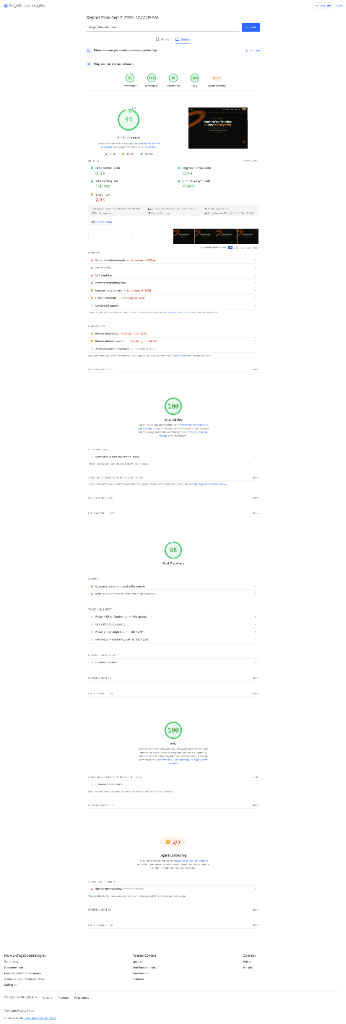
Final Desktop Audit: 93 Performance 🟢, 100 Accessibility 🟢, 100 SEO 🟢, 0.6s LCP, 180ms TBT.
Final Mobile Audit
🟠 Throttled CPU 4G Simulation (83/100)Mobile Web Vitals Breakdown
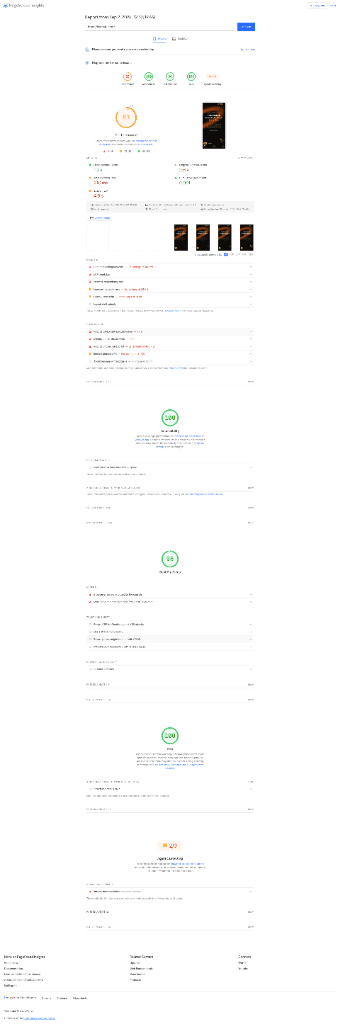
Final Mobile Audit under CPU throttling: 83 Performance, 100 Accessibility, 100 SEO.
Lighthouse Checkpoints & Agentic Crawl Verification
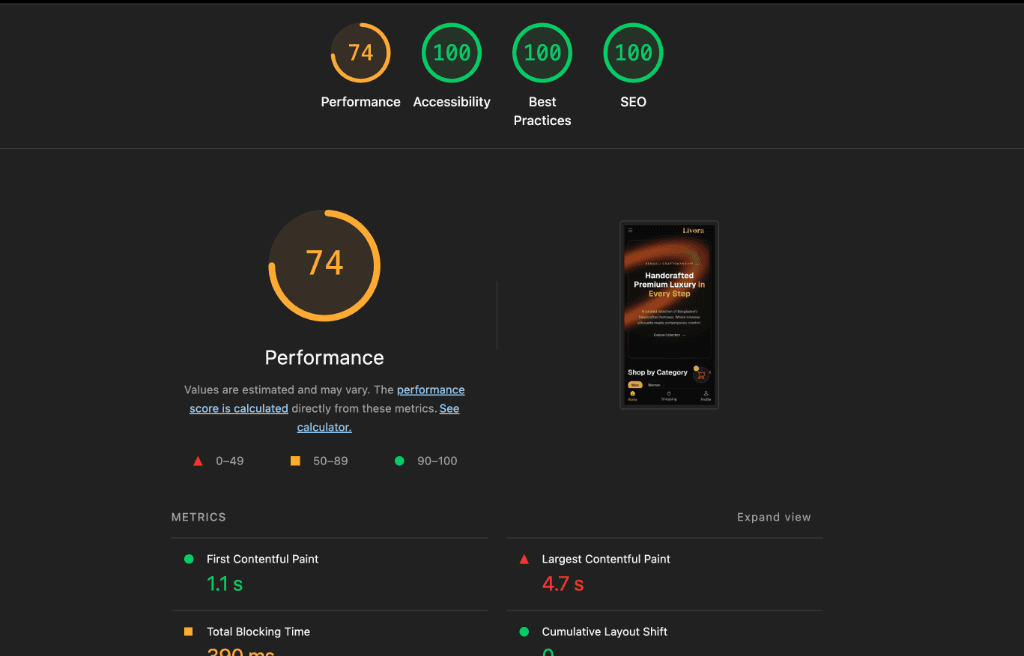
Mobile Lighthouse report confirming 100% SEO, 100% Accessibility, and 96% Best Practices.
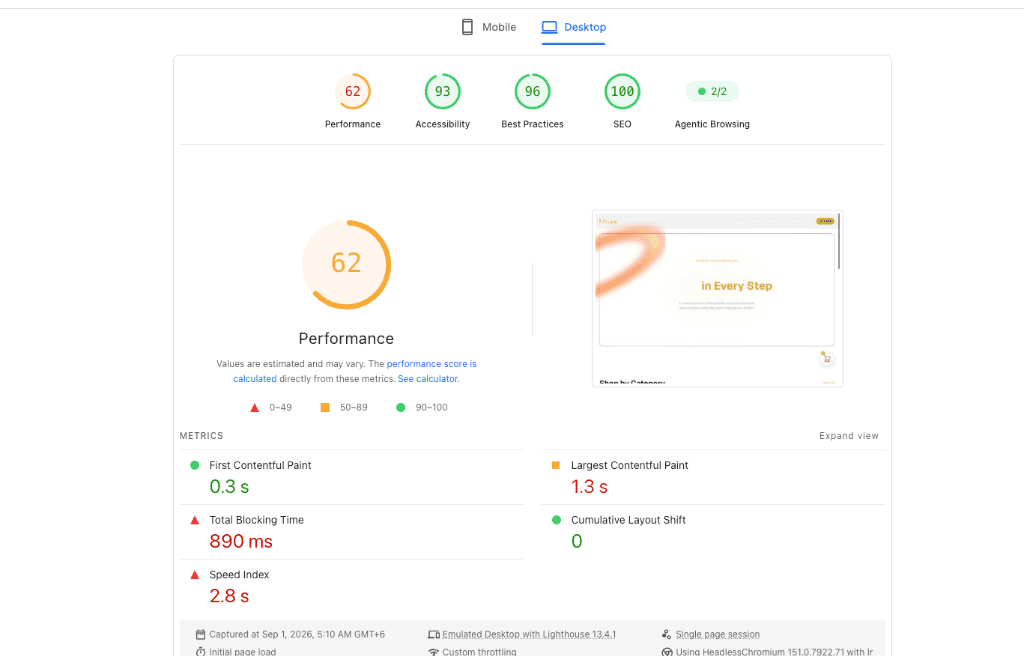
Mid-sprint desktop audit checkpoint reaching 93 Accessibility with verified Agentic Browsing directives.
Detailed Metrics Progression & Net Improvement
Complete before-and-after audit benchmarks across Core Web Vitals and Google indexing parameters
| Metric / Audit Dimension | Initial Baseline | Final Achieved Status | Total Net Improvement |
|---|---|---|---|
| Desktop Performance | 61 / 100 | 93 / 100 | +32 Points (Green Zone) |
| Mobile Performance | ~50 / 100 | 83 / 100 | +33+ Points |
| Accessibility (A11y) | 82 / 100 | 100 / 100 | +18 Points (Perfect 100) |
| Best Practices | 96 / 100 | 96–100 / 100 | Production Grade |
| SEO Rating | 100 (1 Indexed) | 100 / 100 | Full Catalog & Schema |
| Desktop LCP | 1.7 s | 0.6 s | 64% Faster |
| Mobile LCP | 4.7 s | 2.5 s | Cut in half (47% drop) |
| Desktop TBT | 640 ms – 890 ms | 180 ms | 72% CPU Reduction |
| Mobile TBT | 390 ms+ | 210 ms | 46% CPU Reduction |
| Cumulative Layout Shift (CLS) | 0.000 | 0.001 | Absolute Visual Stability |
Key Engineering Takeaways
Core principles derived from this performance sprint that can be systematically applied across modern React and Next.js applications.
Don't just render drawers hidden; don't mount them until opened
Using CSS display: none or default Ant Design drawer components still forces the browser to evaluate JavaScript and construct DOM structures during initial hydration. Lazy-loading and conditional mounting ({open && <Drawer />}) saved over 2.2 seconds of mobile LCP delay.
Keep Analytics and Life-Cycle Tasks Off the Critical Path
requestIdleCallback is one of the most underutilized browser APIs for Next.js applications. Moving route and device trackers to idle callbacks protects your Total Blocking Time (TBT).
Structured Data is the Key to E-Commerce SEO
Googlebot prioritizes crawl budgets when pages provide valid, error-free BreadcrumbList and Product schemas with correct canonical URLs and open robot permissions.
Hardware-Accelerate Complex CSS
Heavy SVG blur filters and animated gradient borders can heavily tax mobile CPUs. Adding transform: translateZ(0) offloads rendering to the GPU and prevents costly forced reflows.
Related Codebase References
Key modules and architectural anchors updated during this optimization sprint
Want to scale your web application's speed and SEO?
Let's connect to discuss technical architecture, Core Web Vitals optimization, or full-stack Next.js engineering for your product.